Tripod balloon light: 60 to 1400 W on a 4.8 m mast
One inflatable head, one folding tripod, one person to set it up. The line runs from a 60 W head that fits in a car boot to a 1400 W head that lights eight thousand square metres, and the choice is almost always made on coverage rather than on wattage.
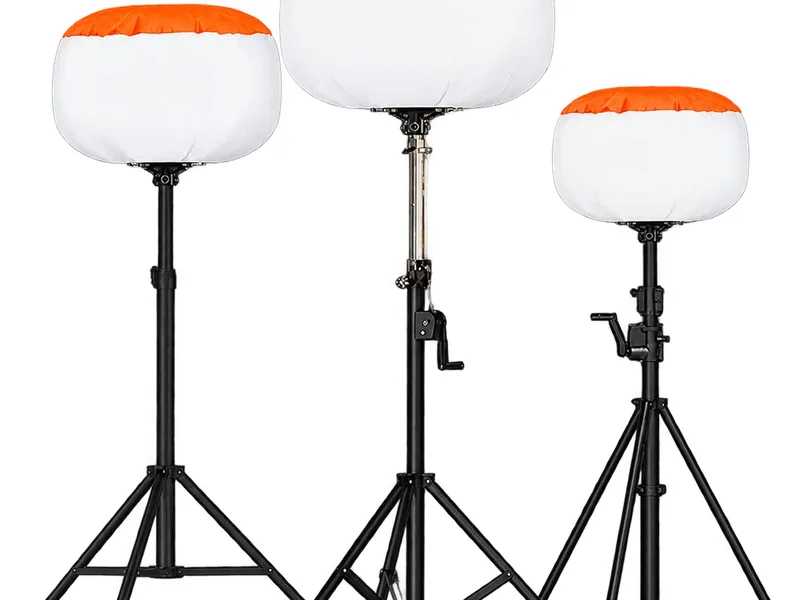
The head is inflatable fabric over a modular LED array, and the tripod carries it to 4.8 m. Nothing on the lamp needs a warm up, which is why a site can be lit in the time it takes to unfold the legs.
Builds in this line (2)
The two power tiers worth a page
Every wattage from 60 to 1400 W is built on the same head and the same tripod family. These two pages carry the numbers buyers ask for most often.
Power against coverage
Coverage is the maximum area the head is rated for, measured at the recommended mounting height. Area rises faster than wattage, which is why the largest head is not the automatic answer.
| Head | Output | Max coverage | Head weight | Balloon (D x H) |
|---|---|---|---|---|
| 60 W | 9,600 lm | 452 m² | 1.9 kg | 40 x 25 cm |
| 240 W | 38,400 lm | 1,385 m² | 4.2 kg | 52 x 35 cm |
| 320 W | 51,200 lm | 1,521 m² | 6.3 kg | 60 x 38 cm |
| 600 W | 96,000 lm | 3,848 m² | 8.4 kg | 64 x 39 cm |
| 1000 W | 165,000 lm | 6,362 m² | 11.4 kg | 100 x 56 cm |
| 1400 W | 224,000 lm | 8,171 m² | 12.8 kg | 100 x 66 cm |
Head weight is the lamp alone. The tripod carries it, and the mast load rating is what decides which tripod goes with which head: a 1400 W head on a 20 kg tripod is a fall waiting for a gust.
Why the light is soft, and why that matters
A balloon light is a bare LED array inside an inflated diffuser. The fabric spreads the output over its whole surface, so the light arrives from a large area instead of a small one. The result is a lit area with no hard shadow and no bright core to look into.
On a road job that changes the working conditions rather than the numbers. Workers stop shielding their eyes when they walk past the tower, the edges of the lit area stay usable, and a camera can expose for the scene instead of for the lamp. It is the reason a balloon is specified for paving, patching and event work where a floodlight of the same output would be pointed away from people.
- Head
- Inflatable diffuser over a modular LED array
- Tripod
- Folding legs, telescopic mast, 2.0 to 4.8 m
- Diffusion
- 360 degrees, no hard shadow edge
- Colour
- 5000 K on the white heads
- Input
- AC 100-277 V, DC 12-48 V on the small heads
- Dimming
- 3 step from 320 W upward
- Filter
- Replaceable insect and dust filter
- Protection
- IP54 on the head
Which head for which site
The quick version, before the specification table.
- Inspection and small repairs: 60 to 240 W. One person carries it, the tripod fits in a van, and 9,600 to 38,400 lm is enough for a footpath or a service pit.
- Road patching and utility work: 320 to 600 W. 51,200 to 96,000 lm covers a working area of roughly 1,500 to 3,800 m² at a usable level.
- Paving crews, emergency response, large sites: 1000 to 1400 W. A single head reaches 6,362 to 8,171 m², which is where the alternative used to be two metal halide lamps on a trailer.
- Events and film: go to the RGBW line for colour, or keep the white head and add a second unit for wrap. Two 320 W heads on opposite sides often read better than one 1000 W head in the middle.
Coverage figures assume the head at the top of its recommended mast and a working level around 50 lux. A site that needs 100 lux over the same area needs twice the output, so ask for the lux target before the wattage.
Before the order
Four things that decide whether the tower is usable on site, and none of them is the wattage.
- Ground: a tripod needs a level surface or a ballast. Soft sand and fresh asphalt are the two surfaces that catch buyers out.
- Wind: the balloon is a sail. Ask for the wind speed the tripod is rated to with the head mounted, and stay under it.
- Power: mains, a power station or a generator. The 60 to 240 W heads take DC 12-48 V as well as mains, which is what makes them work from a vehicle.
- Transport: the head packs to a bag, the tripod does not. Two trips in a small van is normal for the 4.8 m mast.
- Range
- 60 to 1400 W, nine heads
- Top output
- 224,000 lm
- Mast
- 2.0 to 4.8 m, folding tripod
- Ask for
- Lux target, wind rating, plug type
Send the site, the hours and the power.
Site type, the hours the light has to run and what power is available is enough. The reply is a build, a specification sheet and the option list for each line item.