Portable LED floodlight: 200 to 1500 W, IP66
Directional light for the job the balloon cannot do: a long throw down a trench, a beam on a sign face, a work area that needs a defined edge. Same tripods, masts and carts as the balloon line, so a fleet can share the mounts.
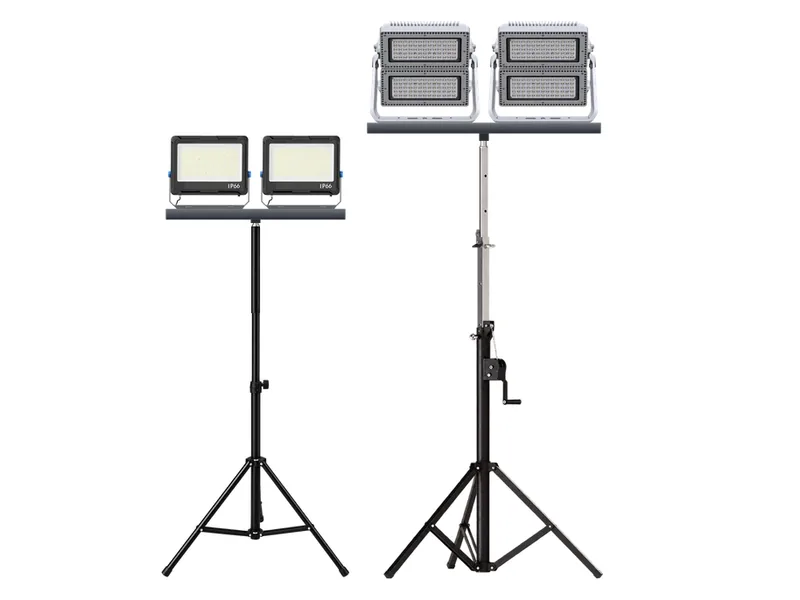
Aimed light for the jobs a balloon cannot do: a long throw, a sign face, a working area that needs a defined edge. The heads share the tripod, mast and cart range with the balloon line.
Builds in this line (2)
Two power tiers
Up to about 500 W the head rides a standard tripod. Above that the mast, the load rating and the aim change.
Head range
Efficacy is rated at 150 lm/W, so the lumen figure follows the wattage. Dimensions grow with the head, which is what decides the mount.
| Head | Output at 150 lm/W | Size | Mount | Typical job |
|---|---|---|---|---|
| 200 / 250 W | 30,000 / 37,500 lm | 425 x 385 x 145 mm | 2.0 or 2.8 m tripod | Trench, footpath, signage |
| 400 / 500 W | 60,000 / 75,000 lm | 735 x 450 x 190 mm | 2.8 m tripod | Road patch, yard, loading bay |
| 600 / 750 W | 90,000 / 112,500 lm | 980 x 450 x 190 mm | 4.8 m mast, 40 kg | Wide site, rail work |
| 800 / 1000 W | 120,000 / 150,000 lm | 735 x 715 x 145 mm | 4.0 m mast, 80 kg | Bridge, plant, large yard |
| 1200 / 1500 W | 180,000 / 225,000 lm | 464 x 1069 x 183 mm | 3.8 m mast, 80 kg | Long throw, tower replacement |
Lumen figures are calculated from the rated efficacy, not measured per unit. A tender that needs a measured figure should ask for the test report for the exact head.
Beam, glare and the trade against a balloon
A floodlight puts the light where it is aimed, which is an advantage down a trench and a problem next to people. The head is bright to look at, the edge of the beam is visible, and anything outside the cone is dark. A balloon does the opposite: it fills the area evenly and gives no defined edge.
Most large sites end up with both. Balloons over the working area where people walk, floodlights on the perimeter, the sign face or the long approach. Because the tripods, masts and carts are shared, the second type costs the heads and nothing else.
- Power
- 200 to 1500 W per head
- Efficacy
- 150 lm/W, plus or minus 5 percent
- Protection
- IP66 on the lamp head
- Colour
- 3000 to 6500 K
- Beam
- 10, 30, 60, 90 degrees, plus asymmetric 80 x 150
- Dimming
- 0-10 V optional
- Housing
- Die cast aluminium, glass cover
- Warranty
- 5 years
Choosing the beam
Beam angle is the specification that decides whether the light lands on the job.
- 10 to 30 degrees: long throw. A sign face, a tower, a bridge deck seen from the ground.
- 60 degrees: general site work at close range, where the head sits low and the area is wide.
- 90 degrees and asymmetric: a lit rectangle with a soft edge, which is what a working area next to a live lane needs.
- Two heads instead of one: aiming a pair is usually better than overdriving a single head, and it keeps a spare on the vehicle.
Asymmetric optics are the ones to ask about for road work: the light is pushed forward and cut off at the back, so it does not blind the lane behind the tower.
Before the order
Three numbers that decide the mount, and one that decides the cable.
- Head weight and mast load: a 1500 W head on a 20 kg tripod is out of rating. Match the head to the mast, not the other way round.
- Throw distance: the beam angle has to suit the distance to the surface, or the light lands as a hot spot.
- Cable and plug: 1500 W at 230 V draws about 6.5 A. Local plug type and cable length are order details, not afterthoughts.
- Range
- 200 to 1500 W
- Efficacy
- 150 lm/W
- Beam
- Symmetric and asymmetric
- Ask for
- Throw distance, mount, plug type
Send the site, the hours and the power.
Site type, the hours the light has to run and what power is available is enough. The reply is a build, a specification sheet and the option list for each line item.