Battery or generator: powering a light tower off grid
The lamp decides how much power the tower needs. The shift decides where that power comes from. Most of the argument is settled by two numbers: the continuous load and the hours.
The arithmetic that settles it
A power station is rated in watt hours, and a lamp is rated in watts. Divide one by the other and subtract about ten percent for the inverter, and the answer is the runtime at full output. A 2,000 Wh station on a 320 W lamp gives about six hours; on a 1,000 W lamp it gives under two.
A generator is rated in continuous kilowatts. The load has to sit under that rating with margin for a hot night, and the fuel tank decides how long it runs before somebody refuels. A 2.2 kW set carries a 1,400 W head with about 800 W spare, which is enough for a second small head or a charger.
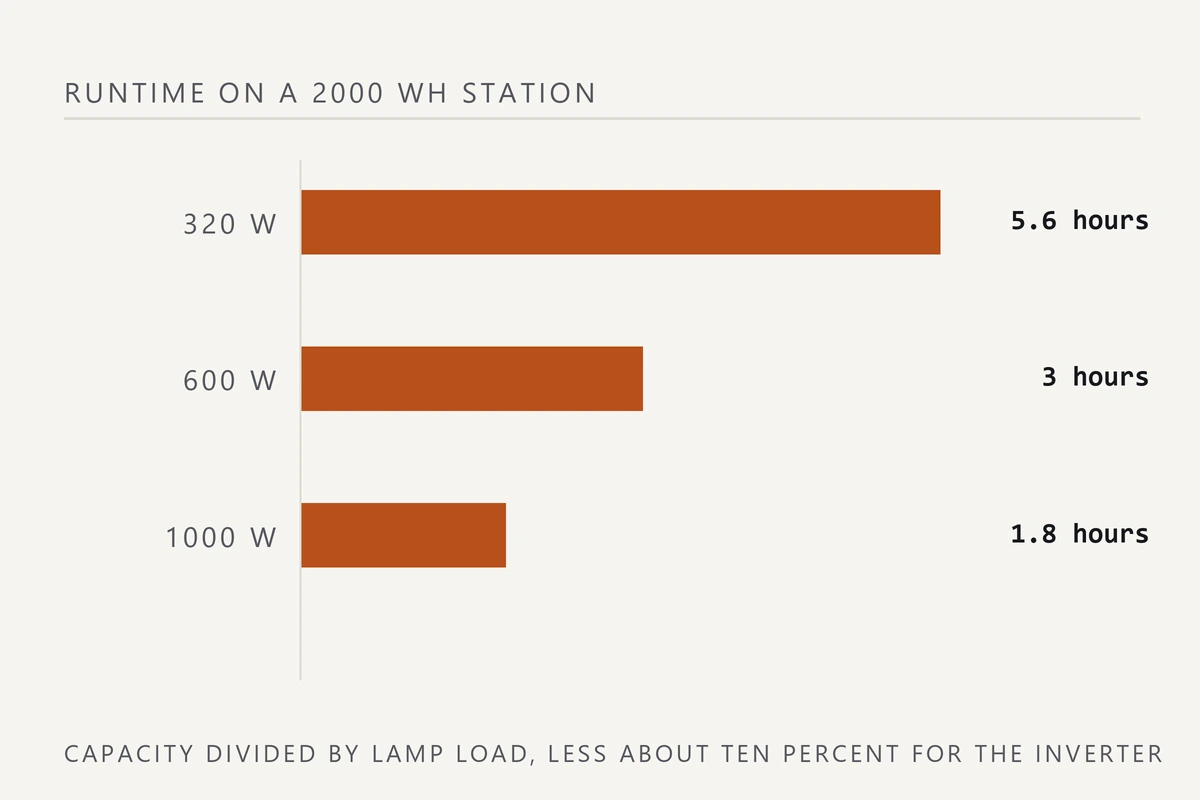
What a battery buys
Silence, no exhaust at the lamp, instant start, and the ability to stand where people are working: a tunnel, a hospital car park, a residential street at night, an indoor job. A station is also lighter than a generator of the same output and needs no fuel handling.
The cost is runtime per kilogram. A 2,000 Wh station weighs 23 kg and runs a 320 W lamp for six hours. A generator that runs the same lamp for twenty hours weighs more, but it refuels in a minute and does not care how cold the night is.
What a generator buys
Runtime without arithmetic. A 4.2 L tank at a moderate load runs for hours, and a refuel resets the clock. It also runs any lamp in the range, including the 1,400 W head that no sensible battery pack will carry for a shift.
The costs are noise, exhaust, fuel logistics and the fact that a generator cannot be used indoors without extraction. On a residential street at night, that last point ends the conversation regardless of the economics.
| Item | Battery station | Petrol generator |
|---|---|---|
| Runtime at 320 W | About six hours on 2,000 Wh | Many hours on one tank |
| Runtime at 1,000 W | Under two hours | Limited by the tank, not the lamp |
| Noise at the lamp | None | Continuous, and it carries |
| Exhaust | None | Must be routed away from the work area |
| Refuel or recharge | Mains between shifts | Minutes, on site |
| Cold weather | Reduced usable capacity | Little effect |
| Indoor use | Possible | Only with extraction |
The arrangement most sites settle on
A generator charging a station during the day, and the station running the lamp at night. The engine stays away from the working area, the lamp does not dip when a tool starts on the same supply, and the site keeps a silent option for the hours when noise matters.
For a fleet, the useful discipline is to standardise the stations across carts and heads. One station type that fits every cart is cheaper to support than three, and it means a failed unit is a swap rather than a lost shift.
Weather, fuel and the things that fail
Two failures account for most dead towers on site: a battery that was never recharged because the charging window was left out of the shift plan, and a generator that ran out of fuel at hour six because nobody owned the refuel. Both are scheduling problems rather than hardware problems, and both are cheaper to settle in the quotation than on the night.
Cold is the third. A battery station loses usable capacity below about 5 C, while a generator does not care. A site that runs through a winter should plan on the winter runtime figure, not the one measured in a warm workshop.
Sizing without guessing
- Write the lamp wattage the tower will actually run, not the largest lamp it could carry.
- Multiply by the hours in a shift, then add ten percent for losses. That is the watt hours needed.
- Add the other loads on the same supply: chargers, tools, a second head.
- Check the continuous rating of the station or the generator against that total.
- Add margin for cold, for an ageing battery, and for the night the shift runs long.
Ask any supplier for the runtime at a named lamp, a stated starting charge and a stated temperature. A runtime figure without those three is a brochure number, and it will not survive the first cold night.
Updated 2026-10-22 · 3 min read. Specifications change without notice; confirm the current sheet before you publish a claim or write a tender document.
Questions that come back
Short answers, before the email.
How long will a 2,000 Wh station run a 320 W lamp?
About six hours at full output, after allowing roughly ten percent for the inverter. Cold weather and an ageing battery both reduce it, so plan on five hours for a winter shift.
Can I run a 1,400 W head from a battery?
For short bursts, yes, with a station rated above 1.5 kW continuous. For a full shift the arithmetic does not work: the pack would need to be several times larger than the ones sized for a cart.
How big a generator do I need?
The total continuous load plus margin. A 2.2 kW set carries a 1,400 W head and leaves room for a charger or a small second head; two large heads on one set needs a bigger machine.
Can a generator charge a power station?
Yes, and that is the common hybrid arrangement. Size the set for the station's charger plus anything else running at the same time.
Which is cheaper per night?
Fuel is usually cheaper per kilowatt hour than battery capacity. The battery wins on noise, exhaust and indoor use, and it loses on capital cost for long, high-load shifts.
Send the site, get the configuration.
Head, mount, power and the specification sheet for each line item, in one reply.